The Winter Storm Kit Checklist (and the Three Things That Expired Since Last Year)
A winter kit built once is a kit that quietly goes stale. The checklist for a house kit, a car kit and a power-out box — and the three items that are almost always expired by now.

There are two kinds of winter kit. The first kind gets built in a burst of good sense one November, usually after a storm has already made the point. The second kind is the same kit, three winters later, with the same batteries in it.
Most households own the second kind. They just don’t know it yet, because nobody has opened the box since the day it was packed.
This is the October job, before the weather makes it urgent: open every kit, count what’s in it, pull what’s dead, and write down the date you did it. Here’s what belongs in each one, and the three items that are almost certainly past their date right now.
The three things that expired since last year
Start here, because this is where the real damage is.
Batteries. Alkaline cells in a cold garage lose charge faster than the package promises, and the ones in the flashlight that’s been sitting switched off for a year are often the first to leak. Every battery in the kit gets tested or replaced. The flashlight gets switched on in your hand, not trusted.
Medications and the first-aid consumables. Painkillers, antihistamines, the children’s doses, anything with a date printed on it. Ointments and eye wash go off; adhesive on old bandages stops sticking. If you keep a week of any prescription in the kit, it’s probably the oldest week you own.
Water. Commercially bottled water is fine for a long time if it’s been kept cool and dark. Water you bottled yourself in rinsed jugs is a six-month supply, not a permanent one. Pour it on the garden and refill.
If you fix nothing else this month, fix those three. A kit with fresh batteries, in-date medicine and clean water is already most of a kit.
The house kit
This is the one that lives where you can reach it in the dark: a hall closet, the mudroom, the bottom of the pantry. Not the basement, if the basement is where the water goes.
- Water: one gallon per person per day, three days minimum. Write the fill date on self-bottled jugs.
- Food that needs no cooking and no refrigeration for three days, and a manual can opener if any of it is in cans.
- Light: one flashlight or headlamp per person, plus one lantern for the room you’ll all end up in. Spare batteries for each, in the original packaging.
- A battery or hand-crank radio, for the one time the phone network is down and the weather service isn’t.
- Warmth: wool blankets or sleeping bags, one per person. Hats. Dry socks. Wool, not cotton.
- First aid: the standard kit, plus a week of each household prescription and the children’s doses.
- Phone power: a charged power bank, checked monthly — they drain on the shelf.
- Cash in small bills. Card readers don’t work in a blackout.
- Paper copies of the things you’d otherwise look up: insurance numbers, the vet, the pharmacy, the neighbor who has a generator.
- Something for the people: a deck of cards, a paperback. Boredom is how a long outage turns into a bad one.
The car kit
Different problem, different box. A car kit assumes you’re stuck somewhere cold for hours, possibly with an engine you shouldn’t run.
- A wool blanket per seat, plus a reflective emergency blanket for the trunk.
- Jumper cables, a small shovel, a bag of sand or cat litter for traction, and an ice scraper that isn’t the broken half of last year’s.
- Water and dense food that tolerates freezing: nuts, jerky, bars.
- Flashlight with its own spare batteries, not borrowed from the house kit.
- Hand warmers, gloves, a hat, boots if you drive in shoes.
- A charged power bank and the cable that actually fits your phone.
- A small first-aid kit and any medication you’d miss within a day.
- Flares or reflective triangles, and a whistle.
The car kit is the one that drifts most. Things get borrowed out of it in summer and never return. Open it in October and count.
The power-out box
If your heat, water or stove depends on electricity, you need a third box that only matters when the lines are down.
- A way to make heat that doesn’t need the grid, used the way its instructions say: a wood stove with dry wood actually stacked, a properly vented propane heater, or the plan to go somewhere that has either. A carbon monoxide alarm with its own batteries sits next to any of them.
- A way to boil water: camp stove and fuel, outdoors or in a space built for it.
- If you’re on a well, stored water for the days the pump won’t run — the house-kit gallon rule, extended.
- A plan for the freezer: a chest freezer stays frozen roughly two days if nobody opens it. Tape the lid shut and put the date on the tape.
- Extension cords and a power strip if a neighbor’s generator or your own ever gets involved, and the knowledge of what that generator can and cannot run at once.
Write the date on the box
Everything above is standard advice; you’ll find versions of it from any emergency management office. The part that isn’t standard, because nobody does it, is this: when you’ve finished checking a kit, write today’s date and what you replaced on a card and tape it inside the lid.
Next October you’ll open the box, read the card, and know in ten seconds whether the batteries are one year old or four. Without the card you’ll do what everyone does, which is shake the flashlight, decide it’s probably fine, and close the lid.
The card is the whole trick. Each kit, one card, one line per year. Three lines in, you’ll know exactly how long your batteries last in your garage, which is a thing no package can tell you.
If you’d rather keep it in a spreadsheet
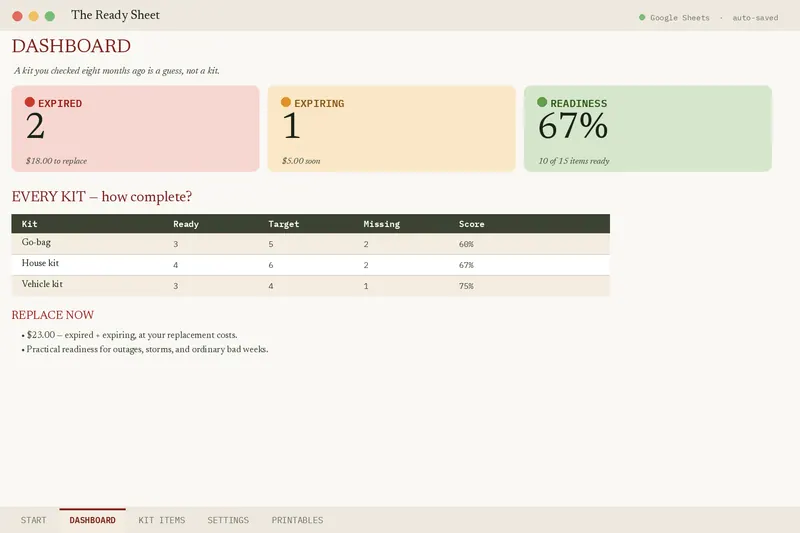
We make a digital Field Kit for exactly this job, The Ready Sheet: list every kit and what’s in it, and it flags expired items, scores how complete each kit is, and totals what topping up would cost. It’s a Google Sheets or Excel file plus a printable pack, and it costs $12.99. It does nothing the card inside the lid can’t do — it just does it for all your kits at once, and it adds up the shopping list.
Either way, the job is the same and it’s an October job. Open the box.

Seed Saving and the Inventory You Do in October
Saving seed is the easy half. Knowing what you have, and whether it will still come up, is what decides next spring's order.
Read the article →
Why Homestead Gifts Get Ordered in October
The good presents for people who keep land get bought early — useful things sell out and personal ones take time. A calm October list.
Read the article →
The Pre-Winter Pantry Count (Do It Before You Need It)
An inventory taken in October is true; one taken in January is done by lamplight and wrong. How to count a pantry, and the four numbers.
Read the article →